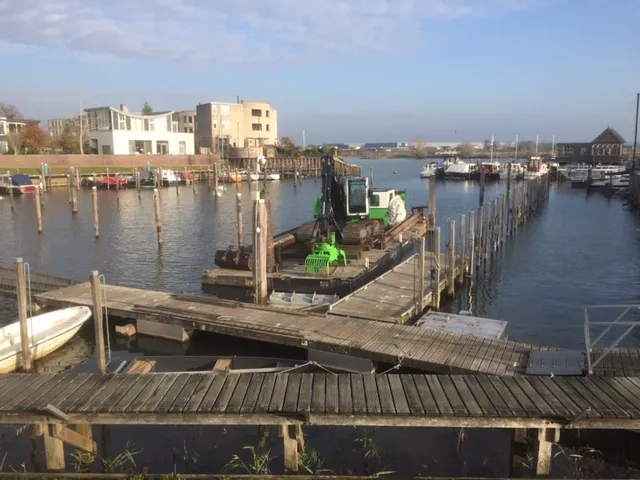
The complete harbour rules of Bovenhaven Watersports Club, approved at the members’ meeting of February 2015.
The amounts in articles 4.3, 13 and 14 are the amounts of February 2015, when these rules were approved; the current price level is on the prices page.
ARTICLE 1: DEFINITIONS
In these rules the following definitions apply:
1.1 Harbour: all waters and grounds with buildings (including the clubhouse) and contents in use by the club.
1.2 Slipway work: taking vessels ashore or launching them, as well as storing vessels in the club’s buildings or on its grounds. 1.3 Harbour master: the person, or their deputy, charged by the board with managing the harbour and who supervises compliance with these rules on the board’s behalf.
1.4 Shed: the part of the harbour building intended for maintenance and repair of vessels and for storage of parts and materials.
1.5 Workshop: the part of the harbour building intended for construction, maintenance and repair of harbour installations.
1.6 Harbour office: the part of the harbour building intended for the harbour master. 1.7 Berth: a berth allocated by the board to a member at the walkway jetty, punt jetty, dinghy jetty or on the racks.
1.8 Board: the board of WSV Bovenhaven.
ARTICLE 2: MEMBERSHIP
2.1 New members must intend to use our watersports facilities and must therefore indicate that they wish to be placed on the waiting list for a berth.
2.2 On applying, the new member must demonstrate that they own a boat or will acquire one.
2.3 The watersports interest of WSV Bovenhaven comes first. If a berth becomes available, the new member is obliged to accept it.
2.4 New members who apply intending only to use the club building are not accepted.
ARTICLE 3: BERTHS
3.1 Subject to article 5.2, berths are allocated tacitly by the board to those members who were allocated a berth in the previous year and who have met their financial obligations to the club. Subject to article 3.2, any remaining berths are allocated to those members who qualify according to a waiting list kept by the board for this purpose, provided the dimensions of the vessel match the size of the available berth.
3.2 No berth is allocated to people resident outside the municipality of Kampen.
3.3 The allocated berth may only be used by the member to whom, and for the vessel for which, it was allocated.
3.4 If the vessel for which the berth was allocated is no longer owned by the member to whom the berth was allocated, the vessel must be removed within 14 days of the transfer of ownership.
The board may investigate the ownership of a vessel, and the member concerned is obliged to cooperate with that investigation.
3.5 If another vessel is acquired whose dimensions no longer match the size of the allocated berth, the berth reverts to the club. The board is not obliged to allocate a replacement berth. The member concerned will be placed on the waiting list if they request this from the board in writing. If the vessel is smaller, the board may allocate another berth. An exchange may take place with the consent of the board and the other party.
3.6 The berth holder must keep the allocated berth in good order. Discharging oil or contaminated bilge water is prohibited. Leaving any kind of waste behind is likewise prohibited. Household waste must be placed only in the containers provided. The use of a through-hull toilet in the harbour is not permitted.
3.7 Storing materials and the like, or installing any kind of fixture, on the jetty and bank area belonging to the berth is not permitted without the board’s consent.
3.8 Tenders may only be moored or stored alongside one’s own vessel or at the dinghy jetty. Without the board’s consent it is not permitted to store materials, boats, trailers, parts, ship’s equipment and the like in the club’s buildings or on its grounds.
3.9 A member who no longer wishes to hold the berth allocated to them must notify the board in writing.
3.10 Where circumstances require, the harbour master is authorised to ask a member to take a berth other than the one allocated. The owner of the vessel must comply with such a request.
3.11 No berth other than the one allocated may be taken without the harbour master’s permission.
3.12 Vessels must be moored or stored so that, whatever the weather, no damage or nuisance (including noise nuisance) can be caused to other vessels and/or harbour facilities.
3.13 If article 3.12 is not complied with, the board may arrange for this at the berth holder’s expense.
3.14 Welding, grinding and machine sanding at the berth are prohibited. When sanding by hand, screening must be used so that other boats are not affected. The harbour master reserves the right to prohibit work where precautions are inadequate.
3.15 Drinking water may not be used to rinse down vessels.
3.16 If the berth is not used for more than one night, the berth holder must notify the harbour master. The harbour master is entitled to use that berth for other vessels.
3.17 Renting out, or arranging the rental of, a vessel for which a berth has been allocated is not permitted from the harbour.
3.18 In the event of a full or partial reorganisation of the harbour, a berth holder must accept another berth designated by the board.
3.19 The use of generators in or on the vessel, and ashore, is not permitted.
ARTICLE 4: MOORING FEES
4.1 The mooring fee for berths is calculated on the basis of the stated box width, regardless of the dimensions of the vessel. The mooring fee is payable in advance.
4.2 The mooring fee is payable per calendar year regardless of whether the vessel is present at the allocated berth. If a berth is not used for more than six months by the vessel for which it was issued, the board may allocate it to another member.
4.3 A member who has not paid the mooring fee within four weeks of receiving the invoice will be sent a written reminder, increased by 25 euros. If the fee plus 25 euros is not paid within 14 days, the member will be sent a further written reminder, this time increased by 50 euros. If the fee is still unpaid after another 14 days, the board will assume the member no longer wishes to claim the berth; the berth then lapses and the member will be informed of this by registered letter. The member must then remove their vessel from the harbour within 14 days. If the vessel has not been removed 14 days after the date of the registered letter, the board is entitled to have it removed from the harbour. The member will be notified of any such intended removal by registered letter.
4.4 Articles 4.1 to 4.3 also apply to mooring fees for berths at the dinghy jetty or on/in the racks, on the understanding that a fixed rate per berth applies regardless of the size of the vessel. The dimensions must not be such that the vessel falls outside the description of a tender. This is at the board’s discretion.
ARTICLE 5: VESSELS
5.1 No berths are allocated to vessels exceeding a total length of 12.00 metres or a beam of 4.00 metres.
5.2 Vessels must be well maintained. The board may refuse or withdraw a berth from owners of poorly maintained vessels, at the board’s discretion.
5.3 Motor vessels must carry a working fire extinguisher suitable for fighting fires on board.
5.4 Running the propulsion system while the vessel is moored is not permitted.
ARTICLE 6: TOILETS AND SHOWER
6.1 Care must be taken when using the toilets and shower so that these rooms remain clean and tidy. Soap residue must be removed from the shower room after use.
6.2 Emptying the contents of chemical toilets into the toilets is prohibited.
6.3 Fish and the like may not be cleaned in the toilets, urinals or washbasins (indoors or outdoors). A separate sink has been installed outside for cleaning fish and similar.
ARTICLE 7: TELEPHONE
7.1 The telephone in the harbour office may only be used in emergencies.
ARTICLE 8: LIABILITY
8.1 The club is not liable for theft, fire or other damage to vessels, contents, ship’s equipment or other property present in the harbour. 8.2 The owner of the vessel is liable for damage to other vessels or harbour facilities caused by them or by their guests or staff, and for damage caused by people carrying out work on the vessel on their instructions.
ARTICLE 9: SLIPWAY WORK
9.1 Arrangements for slipway work must be made with the technical committee, which decides when the requested work can take place.
9.2 Requests for slipway work are dealt with in order of receipt. If cancelled less than 24 hours in advance, the amount due must still be paid, unless the club or the applicant finds another taker.
9.3 If the slipway work cannot take place on the agreed date and time because of water levels, equipment failure or other circumstances, claims are excluded.
9.4 The use of slipway trolleys, hoists or lifting equipment not owned by the club is prohibited without the technical committee’s express permission.
9.5 The technical committee, or a person it designates, directs the slipway work and its instructions must be followed. It may require the owner of the vessel or their representative to carry out any work it considers necessary for the work to proceed properly.
9.6 The owner of the vessel or their representative must store all materials used during slipway work in the places designated by the technical committee.
9.7 The owner of the vessel must provide sufficient manpower. If this condition is not met, the harbour master is not permitted to carry out the slipway work.
9.8 If the cradle on which the vessel is to be placed is unsuitable or does not fit, the extra time required will be charged or the vessel will be relaunched, in which case the slipway fee is still payable.
9.9 All slipway work is carried out at the risk of the owner of the vessel. 9.10 The rates for slipway work are set by the board. The amounts due must be paid to the harbour master immediately after the slipway work is completed; the harbour master will issue a receipt.
ARTICLE 10: SHED AND WORKSHOP
10.1 If the shed has been let, it is not accessible to other people without the hirer’s permission, with the exception of the technical committee, its members and the board.
10.2 In the shed, work on one’s own vessel may be carried out by owners and by people working with them.
10.3 The club’s equipment and tools may only be used exceptionally and with the technical committee’s permission. The owner of the vessel is liable for damage to the club’s buildings, equipment or tools. The technical committee is authorised to intervene regarding the use of the shed, workshop, equipment and tools, and its instructions must be followed without delay.
10.4 Work for the harbour always takes priority in the use of the shed, workshop, equipment and tools.
10.5 Spray painting and similar work are not permitted in the club’s buildings or on its grounds.
10.6 Storing materials, parts, ship’s equipment and the like in the club’s buildings or on its grounds is not permitted without the board’s consent. Where consent is given, the technical committee is required to charge a fee.
10.7 Requests to hire the shed for a set period must be made to the technical committee, which handles applications in order of receipt. On cancellation the rent remains payable unless the club or the applicant finds another taker. The hire period is a maximum of two consecutive weeks. Longer periods require the board’s prior consent.
10.8 Between 22:00 and 07:00 the hirer may not carry out work that causes disturbing noise. This is at the technical committee’s discretion.
10.9 The hirer must ensure the shed remains free of paint and the like. Paint may not be rinsed away and painting materials may not be cleaned in the toilets, urinals or washbasins.
10.10 The shed may, in consultation with the hirers, be let to several people at the same time.
10.11 The hirer must ensure that the shed is locked and the lights are switched off when leaving it during a break in the work. 10.12 The rent due must be paid immediately after the hire period ends.
10.13 The board is required to charge for electricity use.
10.14 The hirer is liable for all damage to the club’s premises, equipment and tools caused by them, by people working with them, or by people working on their instructions.
10.15 At the end of the hire period the hirer must return the shed in the condition it was in at the start. The hirer’s property must be removed immediately once the hire period ends.
10.16 Welding, grinding and other work that may cause fire is prohibited in or near the clubhouse, shed and workshop.
10.17 The use of a deep fryer in or near the shed and workshop is prohibited.
ARTICLE 11: GROUNDS
11.1 Substances or materials prohibited under environmental law may not be used on the harbour grounds. Brushes, paint residue, empty tins and other chemical waste must be taken home.
ARTICLE 12: HOUSE AND CONDUCT RULES
12.1 Everyone in the harbour must maintain order, quiet and cleanliness, observe safety and avoid causing offence by their behaviour. Instructions from the harbour master and the clubhouse manager must be followed.
12.2 Making disturbing noise in the harbour is not permitted.
12.3 Nuisance in the harbour and clubhouse, including noise nuisance, must be avoided. Noise nuisance includes loud music, singing, shouting and the like. 12.4 The clubhouse is to be used as a club building and must under no circumstances take on the character of a bar.
12.5 Smoking is not permitted in the clubhouse.
12.6 Serving staff may not consume alcohol while on duty.
12.7 A party or similar event by and for members may only be held with the board’s express consent, up to a maximum of five per year. Live music, DJs or singers are not permitted without the board’s consent.
12.8 The clubhouse opening hours are set by the board.
12.9 The times for serving alcohol (beer and wine) are set by the board.
12.10 People displaying aggression or other unacceptable behaviour (for example alcohol abuse) will be removed from the clubhouse or harbour by the harbour master or clubhouse manager on duty and will receive a warning from the board. On repetition, article 15.2 applies.
12.11 The use of drugs and similar substances is strictly prohibited. If this is established, the board is authorised to permanently deny the person access to the harbour and to withdraw any membership.
ARTICLE 13: VISITING BOATS
13.1 Visiting boats must be received and assisted in a proper and orderly manner.
13.2 Visitors arriving by vessel must report to the harbour master at the earliest opportunity and pay the mooring fee.
13.3 On the day of departure the visitor must leave the berth before 12:00. If the vessel is still present after 12:00, a further day will be charged.
ARTICLE 14: WINTER STORAGE ASHORE AND IN THE WATER
14.1 Winter storage must be requested from the harbour master in writing before 1 October of the current year.
14.2 Winter storage ashore costs 15 euros. This must be paid to the harbour master in advance; otherwise storage cannot take place.
14.3 Winter storage in the water costs 5 euros per metre per winter season, excluding electricity and excluding membership.
14.4 Boats stored ashore must be removed by 1 April of the following season at the latest.
14.5 Anyone wishing to live aboard their boat during the winter season (1 October to 1 April) must obtain the board’s permission in advance.
ARTICLE 15: COMPLIANCE WITH THE HARBOUR RULES
15.1 All members must give the board and the harbour master or clubhouse manager as much support as possible in promoting the smooth running of the harbour. 15.2 Where a breach of the harbour rules does not cease or is not put right on first request, the board is authorised to deny the person access to the harbour temporarily or permanently and, where appropriate, to withdraw their membership.
ARTICLE 16: FINAL PROVISION
16.1 In cases not covered by these rules and/or the articles of association, the board decides.
These rules were approved at the members’ meeting of February 2015. Bovenhaven Watersports Club, IJsseldijk 12a, 8261 LK Kampen, the Netherlands.
Download the harbour rules here
Harbour rules WSV Bovenhaven